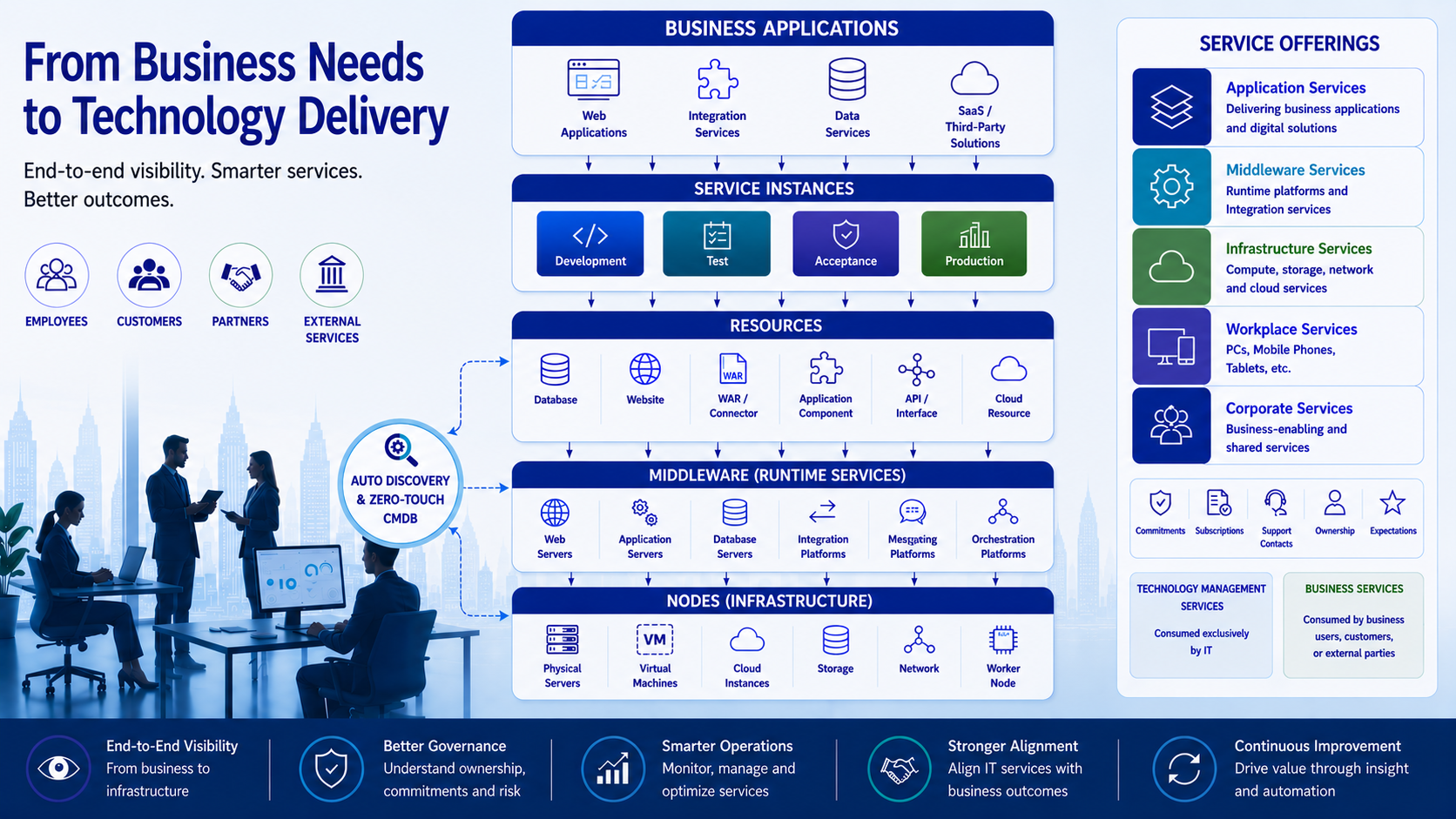
Although often used interchangeably, CMDB and CSDM serve fundamentally different purposes. Confusing the two is one of the main reasons 75% of the CMDB initiatives fail.
What Is the CMDB?
The Configuration Management Database (CMDB) is an operational data store.
CMDB scope
The CMDB contains:
- Deployed configuration items (CIs)
- Runtime instances and their technical relationships
- Discovered and federated infrastructure and platform components
- Service instances and their dependencies
- Operational attributes required for ITSM, ITOM, SecOps, and risk use cases
CMDB characteristics
- Focused on runtime reality
- Populated primarily through automated discovery and integrations
- Continuously changing
- Optimised for operations, impact analysis, incident, change, and risk
- Not authoritative for design-time or portfolio decisions
The CMDB answers: “What is running, where, and what depends on it—right now?”
What Is CSDM?
The Common Service Data Model (CSDM) is a logical reference model.
CSDM scope
CSDM defines:
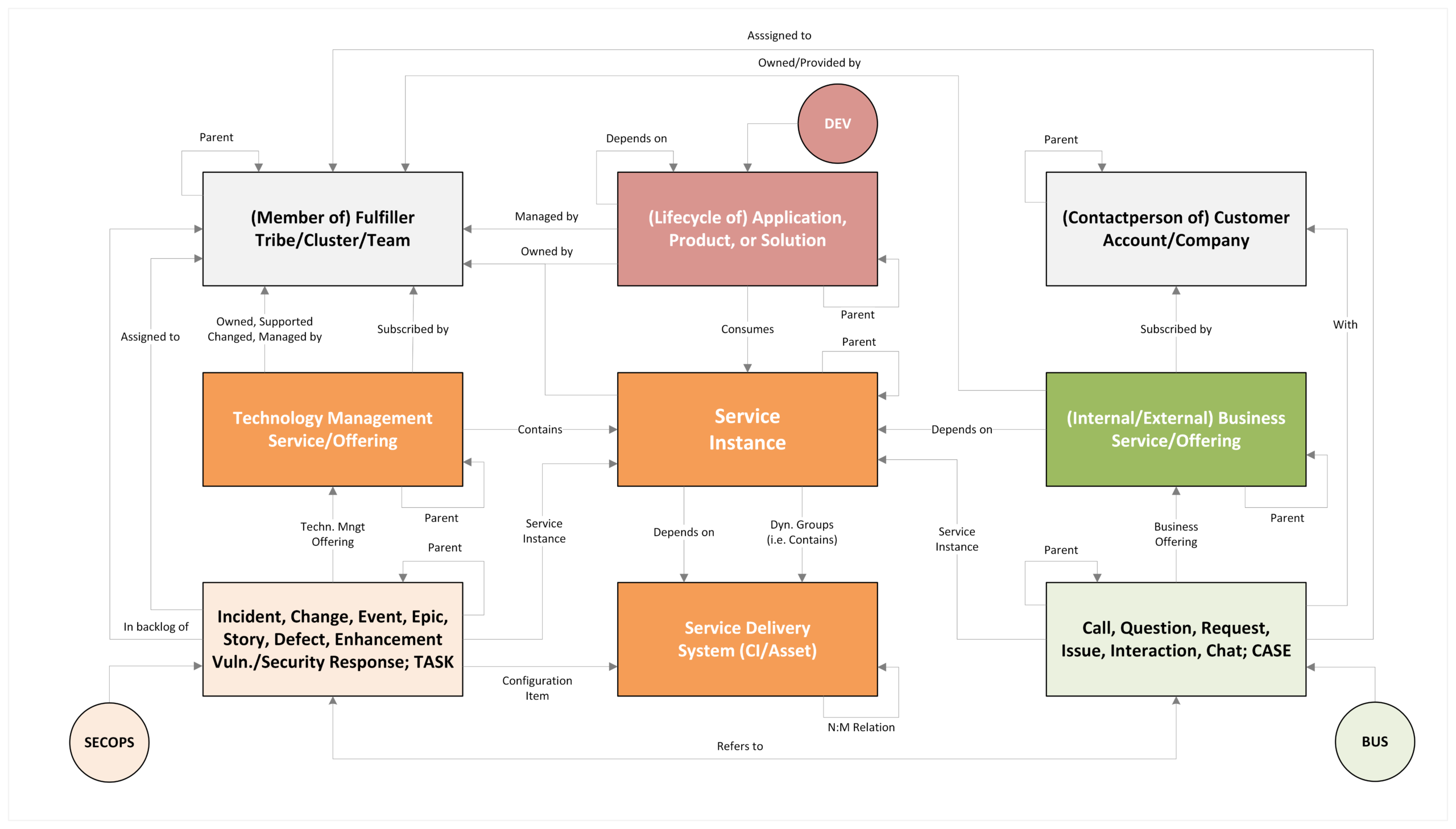
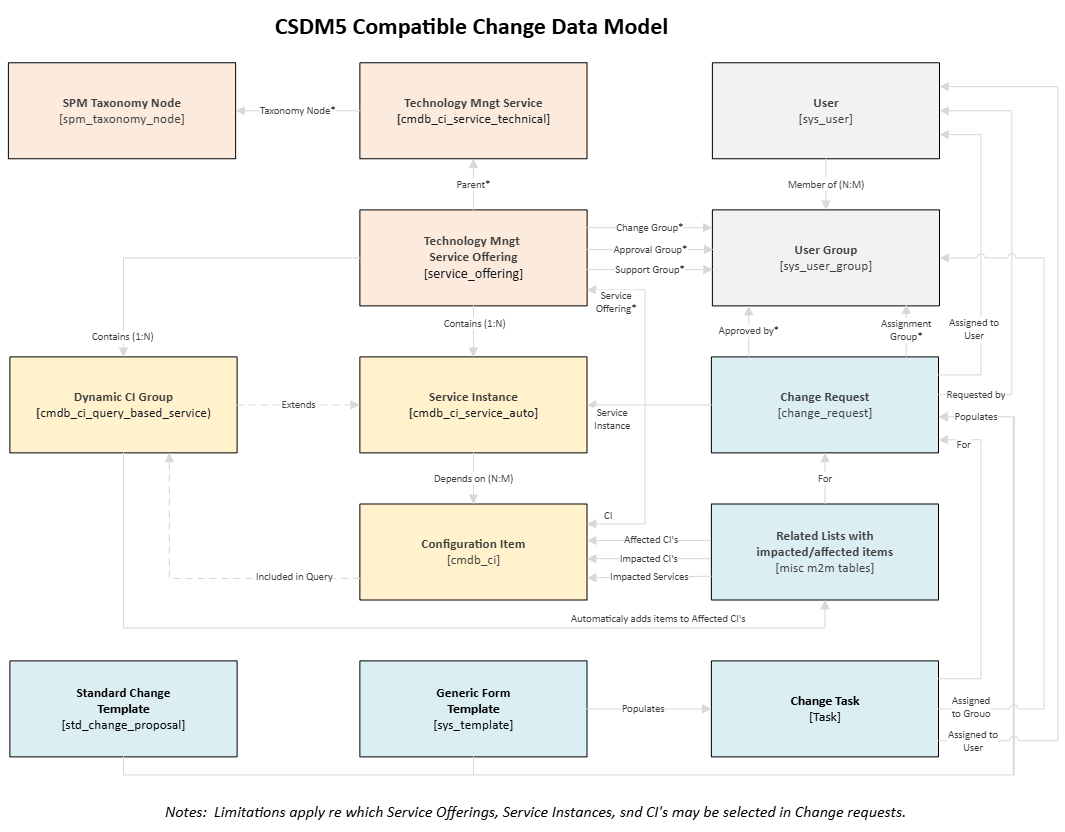
- Which object types exist (applications, services, offerings, instances, products)
- How those objects relate to each other
- Where ownership, accountability, and commitments belong
- Which artefacts are portfolio-managed versus runtime-discovered
CSDM characteristics
- Stable and opinionated
- Service-centric by design
- Independent of tools and discovery methods
- Focused on governance, consistency, and shared understanding
- Applicable beyond the CMDB (APM, ITSM, IRM, TBM, EA)
CSDM answers: “What should exist, how it fits together, and who is accountable?”
The Key Difference in One Sentence
CSDM defines the structure and rules; the CMDB contains the data that conforms to those rules.
Scope Comparison
| Aspect | CMDB | CSDM |
|---|---|---|
| Nature | Operational data store | Logical reference model |
| Purpose | Operational visibility & impact | Structural consistency & governance |
| Focus | Runtime reality | Service & portfolio structure |
| Change frequency | High (continuous) | Low (intentional) |
| Data source | Discovery, integrations | Architecture & design principles |
| Owns data | No (consumes authoritative sources) | No (defines where ownership belongs) |
| Audience | Ops, ITSM, SecOps | Architects, governance, platform teams |
What Belongs Where (Rule of Thumb)
Belongs in the CMDB
- Service Instances
- Deployed servers, containers, cloud resources
- Runtime dependencies
- Discovered software and infrastructure
- Dynamic CI groups
Defined by CSDM (but instantiated in CMDB)
- Business and Technical Applications
- Business and Technology Services
- Service Offerings
- Service Instance patterns
- Ownership and accountability model
Does not belong in the CMDB
- Design-time artefacts
- CI/CD pipelines
- Source code and build metadata
- Ephemeral runtime events
- DevSecOps tool internals
Why This Distinction Matters
When CMDB and CSDM are conflated:
- CMDBs become bloated and unmaintainable
- Discovery data loses context
- Governance becomes manual and political
- DevOps teams resist integration
- Audit evidence becomes inconsistent
When they are correctly separated:
- Discovery becomes safe and scalable
- Service ownership is clear
- Impact analysis works
- Risk and compliance evidence aligns naturally
- DevSecOps and CMDB coexist without friction
The Modern Operating Model
- CSDM provides the stable, service-centric blueprint
- CMDB provides the dynamic, runtime data
- Discovery and federation keep the two aligned
- Portfolio items are managed; runtime items are observed